

Project knowledge base
Scope documents to a single project, and understand how a project base stacks on top of the organization base.
Some documents are true for the whole company. The price list applies to every client, the brand guidelines apply to every piece of work. Others are true for exactly one engagement: this project’s statement of work, this project’s kickoff notes, the minutes of last Tuesday’s call with this client.
Mixing the two makes Lia worse, not better. If every project’s statement of work sits in the organization base, a question about one project can be answered from another project’s contract. Scoping fixes that.
Open a project and go to its Knowledge base tab.
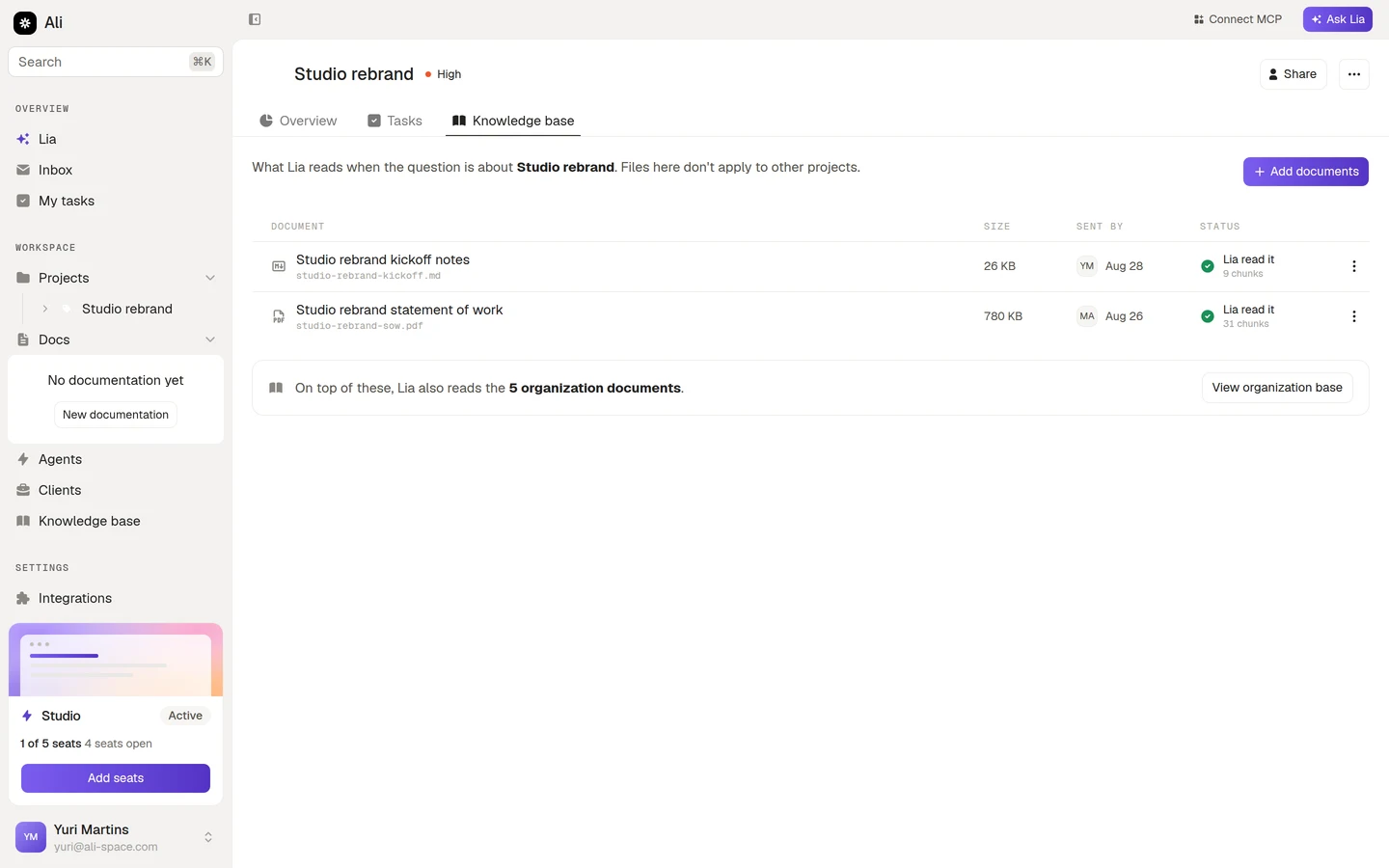
How it works
Documents you send from this tab belong to this project. The line at the top says so plainly: this is what Lia reads when the question is about this project, and files here do not apply to other projects.
Everything else works exactly as it does in the organization base. Same formats, same 40 MB limit, same drag and drop, same statuses, same reprocess and delete. See Sending and managing documents for all of it.
The two bases stack
The card at the bottom of the tab is the important part. It tells you how many organization documents Lia also reads on top of what is listed above, and links straight to the organization base.
So a question about a project is answered from:
- The project’s own documents, plus
- Every document in the organization base
You never have to upload the price list into each project. Put it in the organization base once and every project inherits it.
The reverse is not true. A project document is invisible to other projects and to questions that are not about a project at all. That is the whole point of scoping it.
Deciding where a file goes
One question settles most cases: would this file be wrong to apply to another client?
If the answer is yes, it belongs to the project.
| Send to the organization base | Send to a project base |
|---|---|
| Price list, rate card | That client’s negotiated rates |
| Standard contract template | The signed contract for this engagement |
| Brand guidelines, tone of voice | This project’s creative brief |
| Onboarding playbook, internal policies | Kickoff notes, meeting minutes |
| Anything a new hire should read | Anything that names one client |
When you genuinely cannot tell, the project base is the safer default. A document scoped too narrowly makes Lia say she does not know. A document scoped too widely makes her answer confidently from the wrong file.